Econometric Volatility Filtering and Analytical Option Sensitivities
An Undergraduate Guide to GARCH(1,1), Black-Scholes Greeks, and Martingale Benchmarks in Financial Time Series
1 Why Must Every Financial Forecaster Benchmark Against a Random Walk?
When undergraduate students first train an LSTM or GRU neural network to predict tomorrow’s stock price \(S_{t+1}\) from recent historical prices, they are often thrilled to see a test-set \(R^2\) of \(0.989\) and a smooth predicted curve that hugs the true price line.
However, in an approximately efficient market, daily asset prices follow a near-martingale (\(\mathbb{E}[S_{t+1} \mid \mathcal{F}_t] \approx S_t\)). That means the simplest possible baseline, the No-Change Random Walk (Persistence) \(\hat{S}_{t+1} = S_t\), already achieves \(R^2 = 0.9892\)! This project teaches students how to conduct a rigorous, leakage-free econometric and deep-learning evaluation that separates genuine volatility-regime regularization from the illusion of price-level predictability.
2 Step 1: Leakage-Free \(\mathrm{GARCH}(1,1)\) Filtering and Analytical Black-Scholes Sensitivities
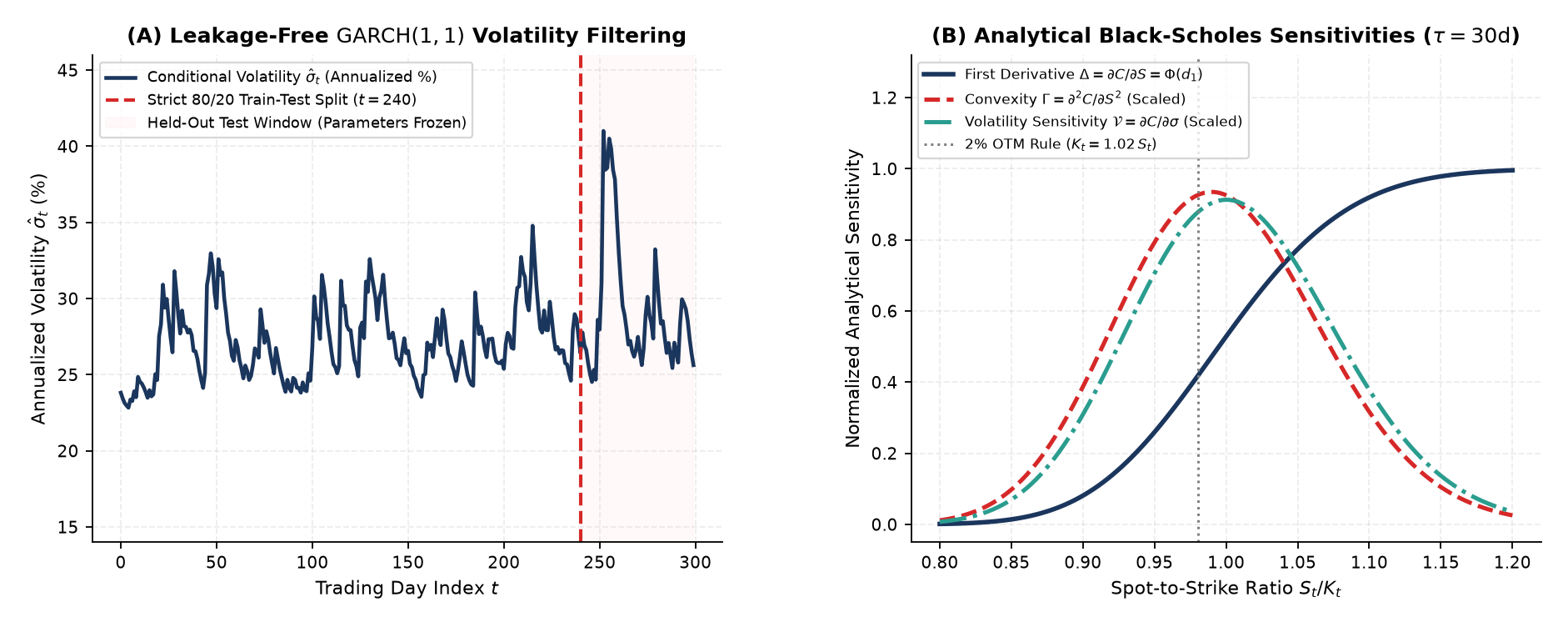
Even when daily price changes \(\Delta S_{t+1}\) have nearly unpredictable signs, return volatility clusters strongly in time. We model time-varying conditional variance \(\sigma_t^2\) using Bollerslev’s (1986) \(\mathrm{GARCH}(1,1)\) recursion:
\[\sigma_t^2 = \omega + \alpha \epsilon_{t-1}^2 + \beta \sigma_{t-1}^2, \qquad \omega > 0, \;\; \alpha, \beta \ge 0, \;\; \alpha + \beta < 1.\]
- Strict Train-Only Parameter Fitting: To prevent look-ahead data leakage, \((\hat{\omega}, \hat{\alpha}, \hat{\beta})\) and all feature scalers (
StandardScaler) must be estimated exclusively on the chronological 80% training split and filtered forward one day at a time on the 20% test split. - Analytical Black-Scholes Sensitivities as Nonlinear Volatility Features: Under the Black-Scholes-Merton PDE, evaluating a standardized 30-day maturity (\(\tau = 30/365\)) and a \(2\%\) out-of-the-money strike convention (\(K_t = 1.02\,S_t\)) at the train-filtered volatility \(\hat{\sigma}_t\) produces four closed-form option sensitivities (Greeks):
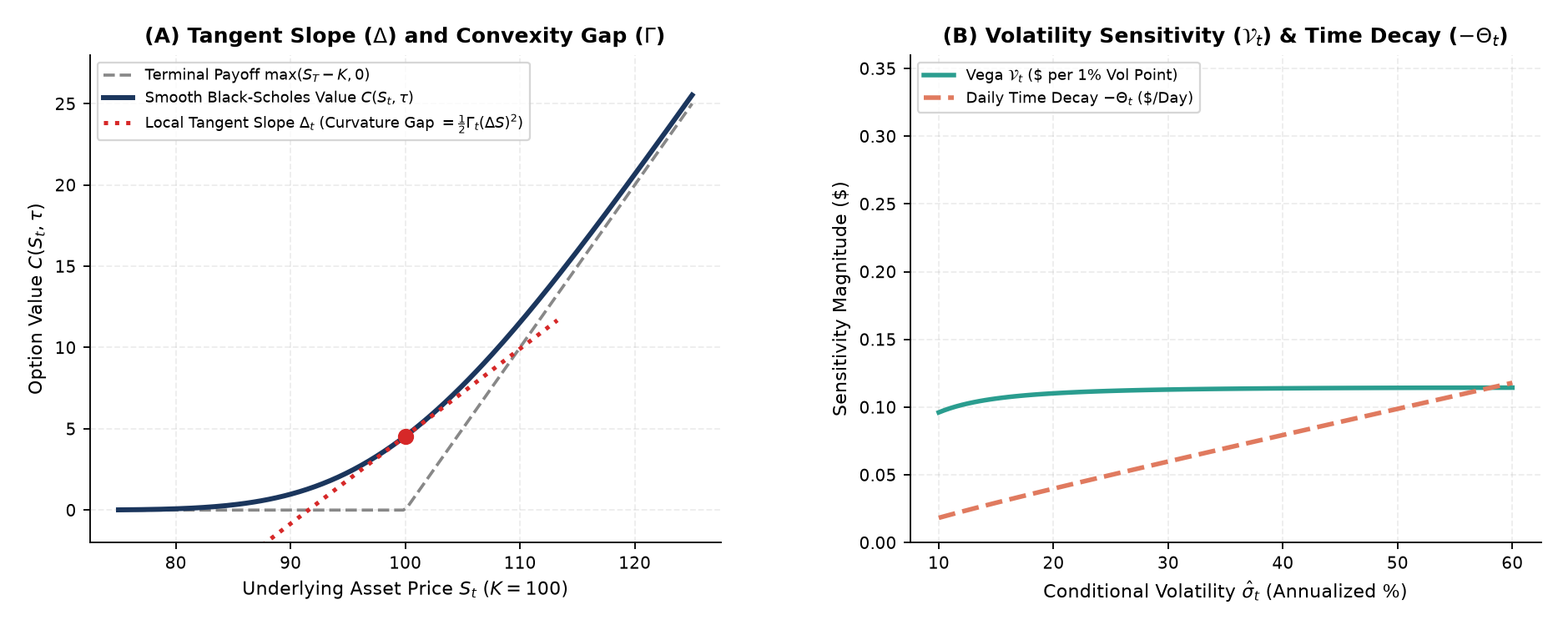
\[\Delta_t = \Phi(d_1), \qquad \Gamma_t = \frac{\phi(d_1)}{S_t \hat{\sigma}_t \sqrt{\tau}}, \qquad \mathcal{V}_t = S_t \phi(d_1)\sqrt{\tau}, \qquad \Theta_t = -\frac{S_t \phi(d_1)\hat{\sigma}_t}{2\sqrt{\tau}} - r_t K_t e^{-r_t \tau}\Phi(d_2),\]
where \(d_1 = \frac{\ln(S_t/K_t) + (r_t + \frac{1}{2}\hat{\sigma}_t^2)\tau}{\hat{\sigma}_t \sqrt{\tau}}\). Notice an important methodological distinction: feeding analytical Greeks into an LSTM-GRU as input features is domain feature engineering, whereas penalizing the partial differential equation residual \(\mathcal{L}_{\mathrm{BS}}[\hat{C}] = 0\) inside the training loss function defines a Physics-Informed Neural Network (PINN).
3 Step 2: Multi-Seed Ablation Against the Random Walk and Binomial Sign Tests
We compare three nested feature tiers across \(5\) random seeds (mean \(\pm\) SD) on \(N_{\mathrm{test}} = 240\) held-out trading days against the No-Change Random Walk:
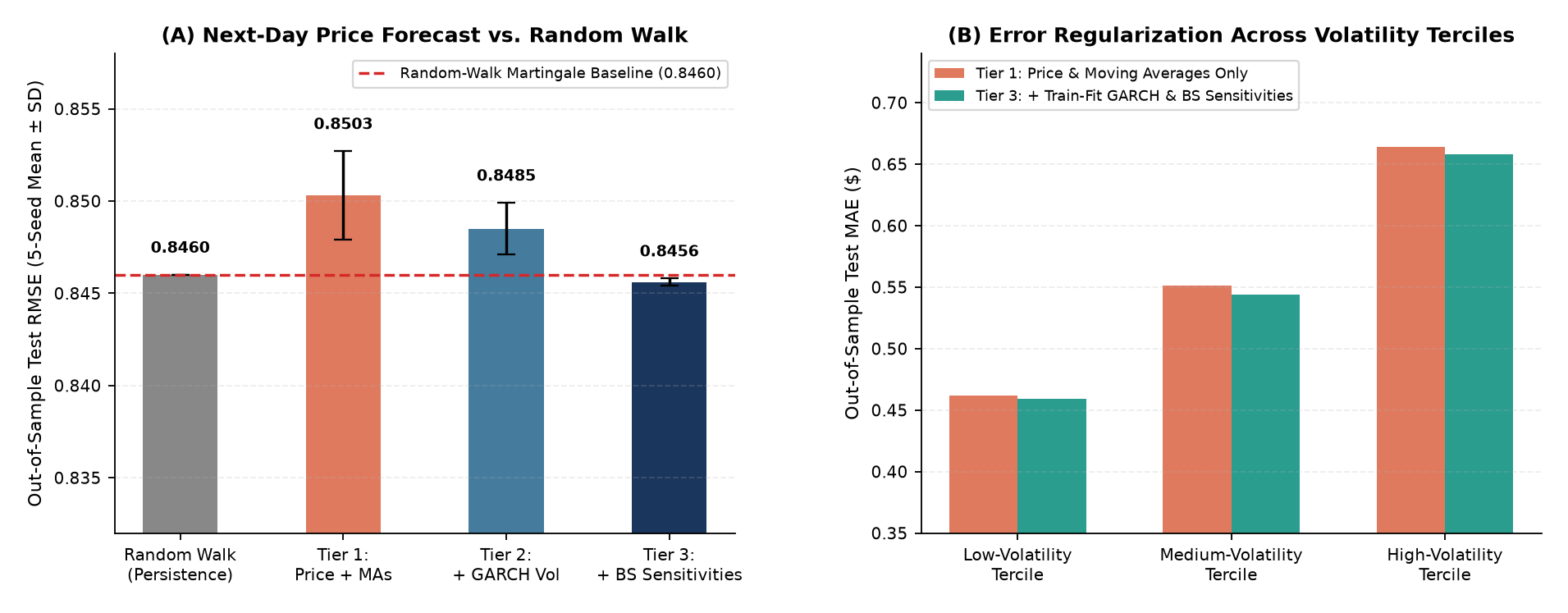
- Tier 1 (Price & Moving Averages Only): Slightly underperforms the random walk (\(\mathrm{RMSE} = \$0.8503 \pm 0.0024\) vs. Random Walk \(\$0.8460\), MSE skill \(-1.03\%\)) because lagging moving averages pull predictions away from current price levels during trends.
- Tier 2 (+ Realized & Train-Fit \(\mathrm{GARCH}(1,1)\) Volatility): Reduces error and seed variance (\(\mathrm{RMSE} = \$0.8485 \pm 0.0014\)).
- Tier 3 (+ Analytical Black-Scholes Sensitivities \(\Delta, \Gamma, \Theta, \mathcal{V}\)): Matches the random walk with the lowest cross-seed variance (\(\mathrm{RMSE} = \$0.8456 \pm 0.0002\), MSE skill \(+0.10\%\)) and reduces prediction error in the High-Volatility Tercile (\(\mathrm{MAE}\) drops from \(\$0.664\) to \(\$0.658\)).
- Testing Directional Accuracy Against a Fair Coin (\(50\%\)): Evaluating true next-day directional accuracy \(\operatorname{sign}(\hat{S}_{t+1} - S_t) = \operatorname{sign}(S_{t+1} - S_t)\) yields \(48.75\%\) (\(117/240\), binomial \(p = 0.747\)) for Tier 1 and \(54.58\%\) (\(131/240\), binomial \(p = 0.175\)) for Tiers 2 and 3. Both lie well inside the \(95\%\) binomial confidence interval \([43.7\%, 56.3\%]\) around a \(50\%\) coin flip, confirming that deterministic transformations of past prices cannot manufacture a statistically significant directional edge.
| Feature Tier / Benchmark | Test RMSE (USD) | MSE Skill vs. RW | Level \(R^2\) | Directional Acc. (\(n=240\)) |
|---|---|---|---|---|
| No-Change Random Walk (Persistence Baseline) | \(0.8460\) | \(0.00\%\) | \(0.9892\) | \(50.00\%\) (\(p = 1.000\)) |
| Tier 1: Price + Moving Averages (\(\mathrm{MA}_5, \mathrm{MA}_{10}, \mathrm{EMA}_{20}\)) | \(0.8503 \pm 0.0024\) | \(-1.03\%\) | \(0.9891\) | \(48.75\%\) (\(117/240, p = 0.747\)) |
| Tier 2: + Train-Fit \(\mathrm{GARCH}(1,1)\) Volatility | \(0.8485 \pm 0.0014\) | \(-0.59\%\) | \(0.9891\) | \(54.58\%\) (\(131/240, p = 0.175\)) |
| Tier 3: + Analytical Black-Scholes Greeks (\(\tau=30\text{d}\)) | \(0.8456 \pm 0.0002\) | \(+0.10\%\) | \(0.9892\) | \(54.58\%\) (\(131/240, p = 0.175\)) |
4 Exploring Further: Research Directions
| Research Track | Core Question to Investigate | Tools & Methods |
|---|---|---|
| 1. True Physics-Informed Neural Networks (PINNs) | When predicting option contract prices \(\hat{C}(S, K, \tau)\) directly, how do we use automatic differentiation (torch.autograd) to penalize violations of the Black-Scholes PDE? |
Physics-Informed Neural Networks, Autograd PDE Residuals |
| 2. Asymmetric GJR-GARCH & Leverage Effects | Does replacing symmetric \(\mathrm{GARCH}(1,1)\) with asymmetric \(\mathrm{GJR\text{-}GARCH}\) capture the empirical fact that negative return shocks inflate volatility more than positive shocks? | Maximum Likelihood Volatility Filtering, arch Library |
| 3. Delta-Gamma Hedging Simulation | How do GARCH-filtered Greeks perform when used to hedge an option portfolio in discrete daily rebalances under transaction costs? | Quantitative Risk Management, Monte Carlo Hedging |